Choose the salt-well village around Bo Kluea Tai for a stay centred on the salt-making area, Sapan in Dong Phaya for a village-and-valley visit, or an outlying hillside property when spending time at that particular accommodation is the purpose. These locations belong to the same wider district but are not one walkable hotel neighbourhood. Select the place you want to wake up in before comparing room photographs.
Disclosure: RoamNivo may earn a commission from booking links at no extra cost to you. This location guide uses official destination information and itinerary research; it does not claim a personal inspection or current verification of every approach road.
Search hotels and compare room options
Bo Kluea Tai, Sapan or a remote property?
| Base | Best reason to choose it | What to resolve first |
|---|---|---|
| Salt-well village area | You want the salt-making stop to anchor the visit | Exact entrance, meals and onward pickup |
| Sapan, Dong Phaya | You want time in Sapan itself rather than a brief drive-through | Room position within or outside the village and transport to other stops |
| Outlying hillside accommodation | The property and its setting are the main experience | Final approach, meal provision and what happens if arrival changes |
A listing may use “Bo Kluea” as a district label even when the room is not beside the salt wells. Equally, “near Sapan” may mean a separate hillside address rather than a village stay. Open the exact coordinates, identify the entrance and ask the host to describe the location in relation to your intended stop. The postal district alone cannot answer that question.
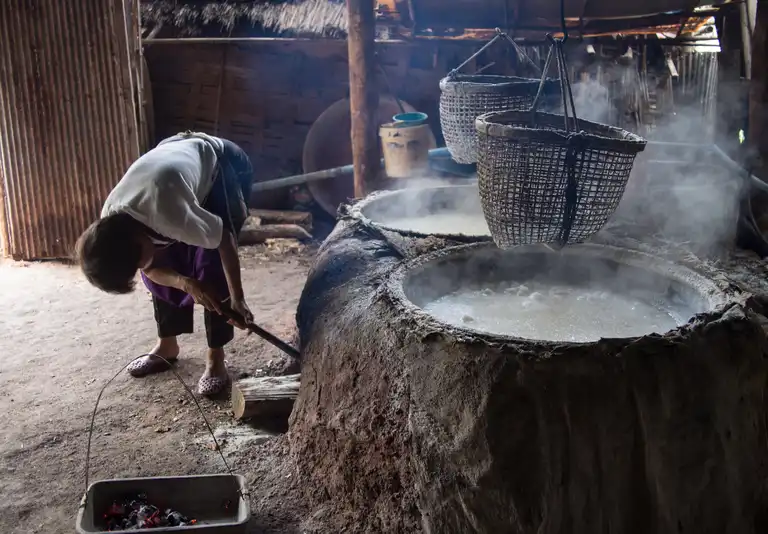

The salt-well village: stay for the local focus
The salt-making area is a distinct reason to visit Bo Kluea. If that is the part of the district that interests you most, investigating accommodation in or around the village keeps your overnight choice aligned with the visit. It avoids choosing a distant room for a photograph and then spending the next morning retracing the route.
Ask how you reach the salt-well area from the accommodation and whether the route is practical on foot for your party. Do not assume that being in the same named village means every entrance has the same access. Confirm the actual location rather than looking only at a broad search-map circle.
Salt-making is a local activity, not a performance guaranteed by your hotel booking. Ask locally about what visitors can see during your stay and respect working areas. If viewing production is the primary reason for travelling, establish expectations before making a non-refundable reservation. A room close to the village does not guarantee a particular demonstration schedule.
For a single night, keep the plan focused: arrive, settle in, eat, then give the local visit enough unhurried time before departure. Adding Sapan, several viewpoints and a long onward journey can remove the benefit of sleeping here. Choose one main experience rather than using the hotel merely as a late-night checkpoint.
Sapan: book the village you intend to experience
The Tourism Authority of Thailand places Sapan in Dong Phaya within Bo Kluea district. That distinction helps explain confusing accommodation searches: Sapan is a particular destination inside the wider district, not another name for the salt-well village. If your main interest is time around Sapan, centre the search there.
Identify whether the accommodation sits among village lanes, at the edge of the settlement or farther away on a hillside. Those positions offer different days. A village stay may make your intended local wandering simpler; an outlying stay may offer a more private outlook but require transport whenever you leave. Neither description automatically proves quietness or walkability.
Ask for a route to the places you actually want to visit. An attractive river or field photograph may be taken from a shared space rather than your room, and a waterfall included in the destination guide is not necessarily reached from the hotel door. Check the separate approach to each attraction rather than treating everything labelled Sapan as one compact site.
Consider staying long enough to enjoy the accommodation between outings. If you arrive near evening and leave immediately after breakfast, the extra journey to a scenic property may deliver little usable time. A slower overnight or an additional night can make sense when you genuinely want to spend time there; it is not a requirement for every Nan itinerary.

Outlying hillside stays: buy an experience you can actually use
Some travellers want the accommodation itself to be the destination: a long breakfast, reading time and an outlook that changes through the day. In that case, an outlying property can fit better than the busiest sightseeing location. Start by deciding how much time you will remain on site, then examine the room and shared facilities.
Ask whether the advertised view belongs to your booked room, a restaurant or a public terrace. Request a recent photograph when the outlook is a major reason for paying more. Seasonal crops, weather and neighbouring development can all change a view; a promotional photograph is a description of one moment rather than a permanent condition.
Next establish how you get from the main road to the property. Share your vehicle type or transfer arrangement and ask where you unload luggage. If the host proposes a pickup for the last section, confirm its cost, meeting point and availability at your arrival time. Do not assume an ordinary map route captures the full arrival process.
Meal provision is equally important. Confirm dinner days, ordering requirements and breakfast timing. If the property does not serve a suitable meal, identify the alternative and the journey required. This is part of the accommodation cost: a lower room rate can be offset by repeated transport or a meal arrangement that does not suit your party.
Choose the route before allocating your overnight stops
TAT's Nan mountain itinerary distinguishes Highway 1256 from Pua towards Bo Kluea and Highway 1081 through the Santisuk side. Its article is useful for understanding a circuit, but it was published in 2020 and should not be used as a live report of access, closures or journey times. Plan with a current map and verify relevant local conditions near departure.
For a journey from Pua, first decide whether Bo Kluea is your overnight destination or a stop before continuing to Sapan. If Sapan is the main interest, sleeping beside the salt wells solely because the district name matches can create unnecessary backtracking. If the salt-making area is the focus, there may be no need to add a more remote hotel.
For a loop that returns towards Nan, work backward from your final commitment. An airport departure calls for a different margin than a flexible sightseeing day. Consider placing the final night in Nan if that makes the connection easier to organise. Do not attach a tight flight connection to a generic mountain-driving estimate.
The Pua location guide covers the earlier base decision, while the Nan Old Town hotel comparison covers a city night. Keeping these roles separate helps prevent an itinerary from accumulating hotel moves without a clear benefit.
Keep a flexible day that still has a purpose
Choose one priority for each overnight stop and one activity you could omit. If conditions or arrival timing change, you can preserve the main reason for staying without forcing every stop into the remaining hours. A shorter village visit with time to settle in may suit the trip better than completing a long checklist.
Consult the Thai Meteorological Department's current forecasts and warnings, then ask your accommodation about the specific approach and planned local activities. A broad weather forecast and local access information answer different questions. Avoid treating an old itinerary's vehicle advice or a previous guest's travel time as current instructions for your route.
Questions about staying in Bo Kluea
Are Bo Kluea and Sapan the same place?
Sapan is in Dong Phaya within Bo Kluea district. It is a distinct destination from the salt-well village. Check the exact hotel location before assuming you can walk between your intended stops.
Which base suits a one-night salt-making visit?
Investigate the salt-well village area first. Confirm what you can see during your dates and organise arrival and meals around that focus rather than adding distant accommodation by default.
Do I need my own vehicle?
A private vehicle is not the only possible arrangement, but an agreed driver or property transfer becomes important when your room is outside the places you want to visit. Confirm each essential journey in advance.
Does a scenic listing guarantee a private valley view?
No. Check which space the photograph represents and which outlook belongs to your exact category. Shared terraces and room balconies are different products.